Inspection Status for Every Critical Asset
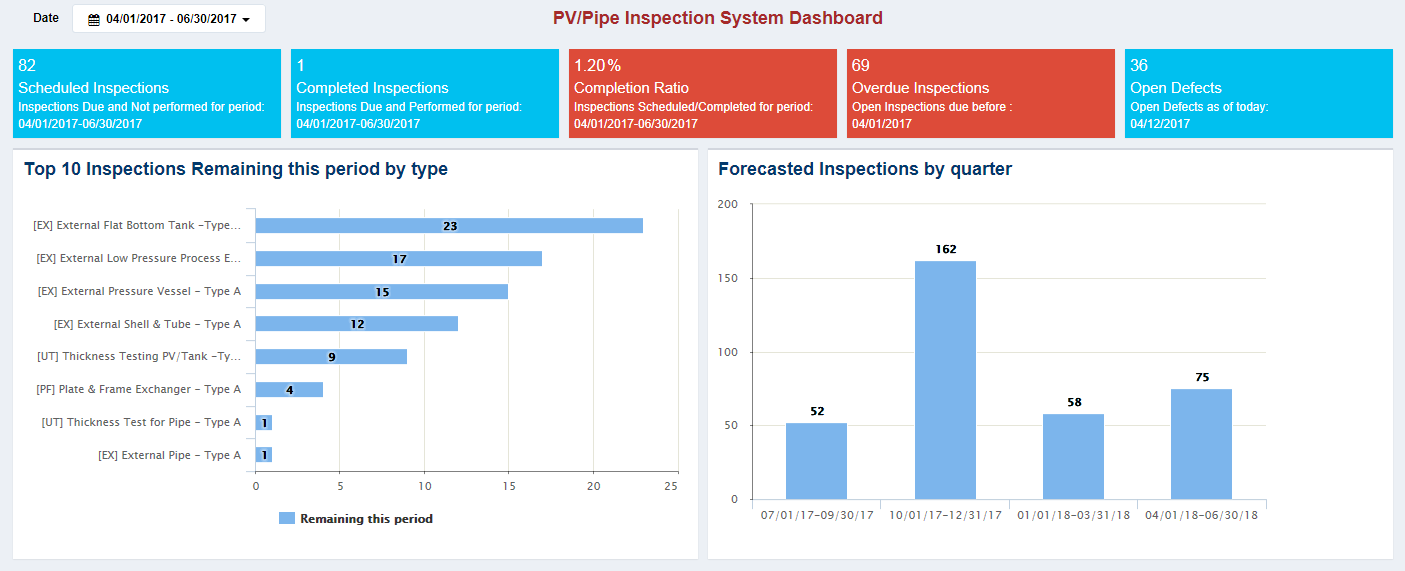
See scheduled, completed and overdue pressure vessel, tank and piping inspections, open defects and forecasted workload on a single dashboard. Screens show sample data.
Inspection management for pressure vessels, tanks, piping and valves: one permanent, auditable record for every asset and every inspection, done by qualified inspectors on time.
Result: Compliance Exposure & Asset Failure
Result: Proactive Risk Control
From the equipment register to an audit-ready inspection history.
Every pressure vessel, tank, pipe and valve gets one master record with its details, inspection history and documents: data sheets, calculations, data plates, drawings, state certificates and repair records.
Each asset carries its inspection frequency and next due date. Inspections are assigned to qualified inspectors by due date, area and department, and upcoming work is forecast.
Inspectors complete the right form for the job: vessel and tank, state, ultrasonic thickness, valve, bolt and other inspection types, set up for your plant's program.
Defects found are logged and followed to closure. Recommendations are tracked, and an exception report shows the ones still open.
Overdue, open, completed and forecasted inspections, defect summaries, equipment inventory and inspection statistics, all exportable to Excel.
A single, permanent record for each asset and a unique ID for every inspection, so the history is complete and there is never any doubt which record is which.
Attach data sheets, calculations, data plates, drawings, turnover packages, state certificates of inspection, repair and material test documents and baseline photos, one at a time or in batches.
Pressure vessels, tanks, piping, valves, totes and more, with the inspection types and forms your program requires, configured for each plant.
Track initial training, continuity, requalification, inspections in the last 12 months and certification, and keep inspector certificates on file.
Assign inspections by due date range, area and department, manage next due dates, and find equipment with no next due date set.
Every defect and recommendation from an inspection is tracked to completion, with summary, detail and exception reports.
Inspection performance by type and area, overdue, open and completed inspections, forecasted inspections, equipment inventory and inspection statistics.
Standard pick lists replace free text, so "CS" and "C.S." are both recorded as Carbon Steel. Legacy records are cleaned up and migrated, and the familiar legacy menu can stay.
Users sign in with their company account. Admin, Inspector and Viewer roles control who can create, edit or only view records.
Mobile and Windows desktop apps with offline mode will let inspectors complete inspections in basements, tank farms, remote buildings and other areas without a connection. Results are saved on the device and sync to ePV Pipe when a connection is available.
See scheduled, completed and overdue pressure vessel, tank and piping inspections, open defects and forecasted workload on a single dashboard. Screens show sample data.
What changes when inspection records move into ePV Pipe.
| Capability | Traditional Process | ePV Pipe |
|---|---|---|
| Inspection records | Spreadsheets, Access databases and paper | One permanent, auditable record per asset and inspection |
| Scheduling | Due dates tracked by hand; inspections missed | Next due dates, assignments, overdue and forecast reports |
| Inspector qualification | Tracked separately, if at all | Training, requalification and certificates on record |
| Equipment documents | Scattered across folders and file cabinets | Attached to the equipment record |
| Data quality | Free text: "CS", "C.S." and "Carbon Steel" | Standard pick lists and cleaned legacy data |
ePV Pipe is in use at multiple U.S. plants of a Fortune 50 manufacturer, where it manages inspection schedules and records for pressure vessels, tanks and piping. Plants that already run eSIRMCA often add it next, especially chemical and process plants.
Plants usually begin with eSIRMCA. When they're ready, they add ePV Pipe and the other systems below, one at a time, when the fit is right.
Improve reliability, reduce risk, and support compliance and audit readiness for your operation.
Request Your Demo